Modes of Communication
Interconnectedness
of the Standards
Two interpretations of the Standards for the purpose
of assessment are represented in the diagrams that follow.
NAEP Model
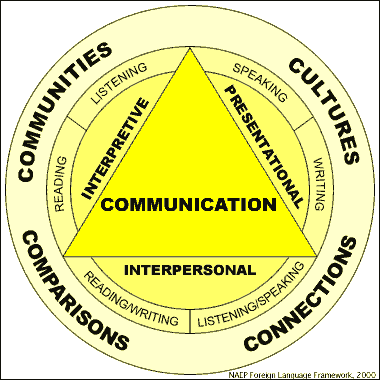
The Center for Applied Linguistics (CAL), with input from ACTFL and the American Institute for Research, developed a framework for world language assessment based on the National Standards. This work was performed for the National Assessment Governing Board, which administers the National Assessment of Educational Progress (NAEP), also called the "Nation's Report Card." A world language NAEP is currently under development. "It is designed to assess twelfth-grade students, who have learned Spanish in a variety of ways and for different lengths of time, at the national level only." A pilot test was conducted in the fall of 2003, and present plans are to include language in the NAEP assessment cycle beginning in 2018.
The NAEP model demonstrates that the "what" of the assessment will be communication skills. The other Cs—Cultures, Connections, Comparisons, and Communities—provide the context for the assessment. They represent the context and content of communication. The NAEP model also demonstrates the relationship of the four skills to the Interpersonal, Interpretive, and Presentational modes.
Wisconsin Model
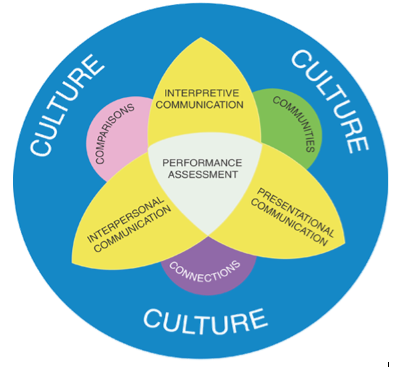
The Wisconsin Department of Public Instruction created a model to illustrate the relationships between state standards (based on the National Standards) and performance assessment. As in the NAEP model, the three modes of the Communication Standard dominate the center of the model. The authors write:
"In a world language classroom, standards influence the curriculum, assessment, and instruction. The three purposes of Communication (interpersonal, interpretive, and presentational) form the heart. Culture is always embedded in the instruction. Connections, Comparisons, and Communities enrich the learning activities. The performance standards inform the assessments that show students their progress toward higher levels of proficiency in using the target language. The focus is on what students can do with the language they are learning." (Sandrock 2002, p. 67)