What am I Assessing?
Cultures, Connections,
Comparisons, Communities
Click for a larger view
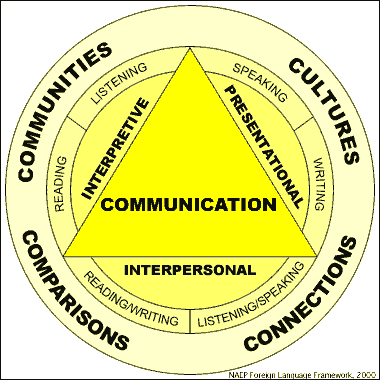
The outside ring of the NAEP graphic contains the other four Cs of the World-Readiness Standards: Cultures, Connections, Comparisons, Communities. These four Cs provide the goals for Communication. Note that there are no lines dividing these four Cs into separate boxes. They are also interrelated.
Imagine the four Cs as the underpinning for all communication. They are on a round base upon which the triangle of Communication rests. Consider the characteristics of each of the four Cs:

Cultures includes not only the products (art, music, monuments, etc) associated with a certain country but also the practices (customs, habits, traditions, etc.) of the people of a certain country. Both aspects help students understand more about the people of the culture: what is important to them and how it shapes their view of the world. The World-Readiness Standards refers to this understanding as perspective. Perspectives is often called the “Third P” in the Cultures Standard: Products, Practices, Perspectives.
Connections emphasizes the content in a language class: content learned in the world language classroom can enrich the students’ understanding of other disciplines. And, content learned in other disciplines can be used as springboards that encourage students to explore topics through the lens of the target language and culture.
Comparisons allows students to compare and contrast the target language and culture with their own, encouraging deeper understandings of both their own and other countries’ language and culture.
Communities takes the language learning beyond the classroom. Students are encouraged to find ways to use their language in their community and beyond via exchanges, travel, communication via the Internet. Language instruction also encourages lifelong learning, sparking an interest in and appreciation for other languages, people, culture that continues throughout the students’ lives.
The four Cs provide the context and content for Communication. Keeping the four Cs in mind (the base that supports the Communication triangle) will guide your choice of an appropriate context and appropriate content in creating a standards-based IPA. Ask yourself these questions as you design the assessment tasks:
- Will the assessment tasks allow students to demonstrate their knowledge and understanding of products, practices, and perspectives of the target culture?
- Will the assessment tasks allow students to demonstrate their knowledge and understanding of other disciplines: Connections?
- Will the assessment tasks allow students to demonstrate they can compare their language and culture to the target language and its culture(s)?
- Will the assessment tasks allow students to demonstrate they can use the knowledge and skills of the target language and its culture(s) outside the classroom?
Keeping in mind that an IPA is the application of what a student has learned to an authentic communicative situation, we consider the NAEP graphic as the visual representation of the assessment framework. The parts create one unified image: there are not different pieces scattered over the page nor are the parts presented in a linear list. The image is an inclusive circle.
See examples of what assessments based on the NAEP framework look like in the classroom.